
Featured post
Why Every Developer Needs a Professional Portfolio
career · portfolio · development · tips
TL;DR
- ▸A portfolio doesn't need to be an elaborate website — a GitHub profile with real projects is enough to start.
- ▸It works as the first handshake with recruiters, clients, and collaborators, before any conversation happens.
- ▸Documenting decisions and lessons learned shows how you think, which often matters more than the specific tech you used.
- ▸It also attracts genuine connections passively, without the fatigue of traditional networking.
- ▸Start with what you already have — today's imperfect version beats the perfect one that only exists in your head.
The first time I really needed to show what I could do was in 2016, during a job interview. I wasn't asked to build something on the spot. They wanted to see something I had already built. Something that was mine.
I didn't have a fancy portfolio website at the time. But I had a side project I'd been working on, hosted on GitHub, with a simple README explaining what it did and why I'd built it. I showed that. It was enough.
 Developer focused on working with a laptop in a professional environment
That experience stayed with me, not because of the stress of not being fully prepared, but because of what it taught me. Having a portfolio isn't about having a polished, complex website. It's about having something to point to. A GitHub profile with real projects, a LinkedIn page with case studies, a simple hosted app. Any of these count. The bar is lower than most developers think.
The market doesn't know you. But it can find you.
There's a quiet asymmetry in the tech market: you can be genuinely skilled and still be invisible to the people who matter. Recruiters go through dozens of profiles a day. Clients search for references before any conversation. Potential collaborators look you up before responding to your message.
In that context, your portfolio, whatever form it takes, is the first handshake.
 Recruiter reviewing candidate documents in a professional interview setting
A resume lists what you say you know. A portfolio shows what you've actually done. That difference is subtle on paper but enormous in practice. It's the difference between asking someone to trust you and giving them concrete reasons to. In a market where more developers compete for the same opportunities every year, that distinction matters more than most people realize.
It's not about selling yourself. It's about reducing friction between your talent and the people who need it.
Credibility isn't declared, it's demonstrated.
There's something interesting about the psychology of hiring: nobody wants to be the first to bet on someone. Everyone wants evidence that others have trusted that person before. That's why case studies work, why documented projects convince, why real examples close deals where polished résumés fail.
When you document a project, even a small one, and explain the problem it solved, the decisions you made, and what you learned along the way, you're doing something that goes far beyond showing code. You're showing how you think. And how you think is often more valuable than any specific technology you know.
Connections you didn't expect
 Colleagues greeting each other in a collaborative work environment
One of the things that surprised me most over the years was how much my portfolio attracted connections I never would have sought out proactively. A post about a problem I'd solved brought a message from someone dealing with the same thing at another company. A project I documented led to an invitation to contribute to something bigger. A conversation that started publicly turned into a long-term collaboration.
Proactive networking is exhausting and often feels artificial. A portfolio with genuine content does something similar, but passively: it attracts people through what you actually are, not through the image you try to project in a social setting.
Your portfolio as a playground
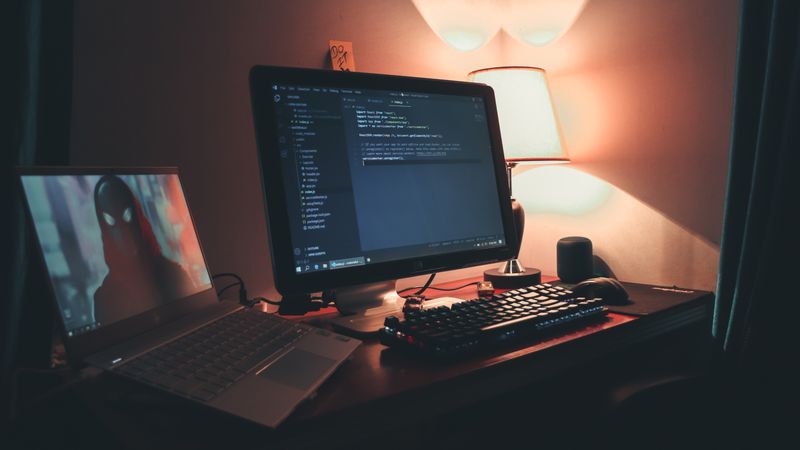 Programming workspace with two screens showing code in a warm, welcoming environment
Having a personal website as a developer is about much more than showcasing polished projects. It's about having a space that is truly yours.
A place where you can experiment freely, a real playground. Where you test new ideas, technologies, patterns, and approaches without pressure. Where you share what you're learning, your thoughts, small discoveries, and even things that didn't work out as expected. It's also a powerful way to show how you think and solve problems, not just the final result.
And the best part? It doesn't need to be big, complex, or fancy. You don't even need your own domain at first. There are great free options like GitHub Pages, Vercel, and Firebase. A simple website is more than enough to get started. Over time, you naturally improve it, refactor things, add new sections, and evolve it, just like any real project.
I've made several rounds of improvements to my own portfolio since launching it, and it looks quite different from where it started. It's still a work in progress. That's exactly the point.
Where to start
If you don't have anything to show yet, the most common trap is waiting for a "real" project or a polished website. Don't wait. Start with what you have: a side project on GitHub, a write-up of something you solved at work, a small experiment with a technology you've been curious about.
The imperfect version that exists today is already infinitely more useful than the perfect one still in your head.
Comments